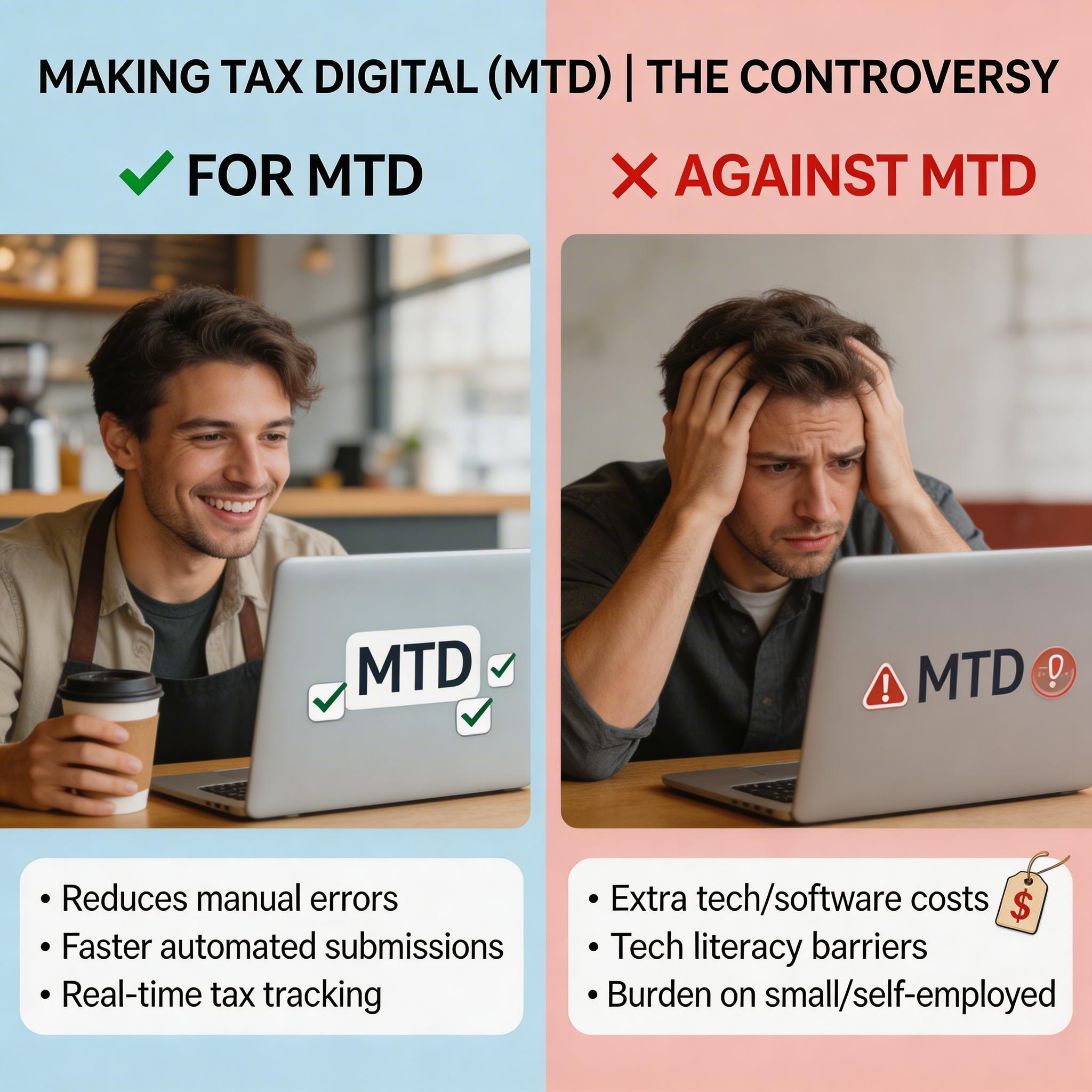
Controversial Making Tax Digital (MTD) initiative
The Making Tax Digital Mandate: A Stakeholder Analysis of Compliance Shifts and Systemic Challenges Ahead of the 2026 Rollout
Strategic Rollout and Phased Implementation
The UK government’s Making Tax Digital (MTD) initiative represents a significant evolution in the nation’s tax administration, moving towards a more digitally integrated and continuous reporting model. This report analyzes the policy’s forthcoming rollout on 6th April 2026, focusing on its multifaceted impact across four key stakeholder groups: tax professionals, small business owners, general taxpayers, and policymakers. The strategic direction of MTD is not that of a single, abrupt mandate but rather an evolving framework designed to build complexity and participation over time. The most critical aspect of this strategy is its phased implementation, which allows for iterative learning and adaptation before wider obligations are enforced. The April 2026 date serves as a pivotal milestone, marking the beginning of the next major phase of this long-term project.
The rollout for Income Tax Self Assessment (ITSA) is explicitly structured in distinct phases, targeting different income brackets at staggered intervals.
+1. The initial cohort of taxpayers required to comply with MTD from 6 April 2026 consists of self-employed individuals and landlords whose gross income exceeds £50,000.
+1. This threshold-based approach ensures that the transition begins with a group likely to have more established accounting systems, potentially easing the initial administrative load on Her Majesty’s Revenue and Customs (HMRC). Following this initial phase, a larger segment of the population will be brought into the system. For the 2027/28 tax year, those with gross self-employment and/or property income over £30,000 will be required to register for MTD and make quarterly submissions.
+1. The marker indicating the activation of these requirements for incomes over £30,000 is set for 6 April 2027. This two-year gap between the first and second phases is strategically significant, providing a crucial window for HMRC to monitor the experience of early adopters, identify systemic issues, and refine both the technology and guidance before expanding the mandate.
This phased approach demonstrates that HMRC is treating MTD as a dynamic framework rather than a static one-off policy. The evolution of thresholds—from £50,000 down to £30,000—signals a commitment to eventual universal application, albeit through a gradual process. The existence of these phases suggests that stakeholders should adopt a forward-looking perspective; preparing for the 2026/27 tax year is not merely about meeting immediate deadlines but about laying the groundwork for future compliance obligations that will inevitably expand. For policymakers, this incremental strategy appears to be a calculated risk management exercise. It balances the ambitious goal of digital transformation against the practical realities of implementation, aiming to mitigate widespread disruption while pushing towards a modernized tax collection system. The policy’s design reflects a global trend where governments seek to channel innovation for public benefit, though they must navigate complex socio-political conditions to ensure acceptance
+1. The success of this strategy hinges on the ability to manage the transition smoothly for each cohort, ensuring that lessons learned from the £50,000+ group inform the support and communication strategies deployed for the larger £30,000+ group in 2027.
Compliance Mandates and Evolving Penalty Structures
The core of the Making Tax Digital for Income Tax (MTD-ITSA) initiative lies in a fundamental shift in how taxpayers must manage and report their financial information to HMRC. These mandates represent a departure from the traditional annual filing model and introduce new procedural and technological obligations that have profound implications for all stakeholders. The central requirement is the maintenance of digital financial records for all transactions, including sales, supplier invoices, and overheads. This effectively necessitates the replacement of paper-based ledgers and spreadsheets with HMRC-compatible software, establishing a digital-first foundation for the entire system. This move away from manual record-keeping is intended to increase accuracy and streamline data transfer between the taxpayer and the tax authority.
Perhaps the most visible change for many affected individuals will be the transition from submitting a single, comprehensive annual Self Assessment tax return to making four quarterly digital submissions throughout the tax year. This increases the frequency of interaction with HMRC and demands a more continuous and accurate record-keeping process. Taxpayers will no longer be able to defer preparation until the final deadline of January 31st; instead, they must maintain up-to-date digital records and submit summaries of their income and expenditure every three months. This shift transforms the compliance burden from a high-pressure annual event into a more distributed, ongoing process. While this may alleviate some of the end-of-year stress, it simultaneously heightens the need for consistent accuracy and timeliness throughout the year.
The penalty regime associated with MTD-ITSA is also undergoing a significant evolution, designed to encourage timely adoption while managing the transition period. For the 2026/27 tax year, a temporary measure has been introduced to ease the initial transition: ITSA taxpayers who are newly required to join MTD will not be subject to late-submission penalties for their quarterly updates. This reprieve acknowledges the substantial effort required to adapt to a new system and aims to prevent punitive actions against taxpayers who may encounter unforeseen difficulties during their first year of compliance. However, this temporary relief is only for the first year of quarterly submissions. From April 6, 2027, a new and stricter penalty regime will be applied to all ITSA taxpayers who are not already required to join MTD.This differential treatment creates a powerful incentive for taxpayers to meet the upcoming deadlines. The table below outlines the key dates and corresponding penalty regimes.
| Event / Tax Year | Affected Group | Submission Requirement | Late Submission Penalties |
|---|---|---|---|
| 2026/27 Tax Year | Self-employed & Landlords > £50,000 (April 2026 start) | Four quarterly digital submissions | Waived for the first year of quarterly updates |
| 2027/28 Tax Year | Self-employed & Landlords > £30,000 (April 2027 start) | Four quarterly digital submissions | To be determined based on the new regime |
| From 6 April 2027 | All ITSA taxpayers not already required to join MTD | Annual Self Assessment return | New, stricter penalty regime applies |
This graduated penalty structure is a carefully considered element of the policy design. By offering a grace period for the initial cohort, HMRC signals an understanding of the practical challenges involved in such a systemic change. At the same time, by introducing a harsher penalty regime for those who delay joining MTD, the government creates a clear disincentive for non-compliance once the transition period concludes. This dual approach attempts to balance enforcement with the need to manage a large-scale administrative overhaul. For all stakeholders, this means that while there is a short-term reprieve, the long-term expectation of strict adherence to deadlines remains firmly in place, underscoring the importance of preparing well ahead of the 2026 and 2027 rollouts.
Impact on Tax Professionals: Adaptation and Opportunity
The rollout of Making Tax Digital (MTD) for Income Tax Self Assessment (ITSA) presents a dual-edged sword for tax professionals, encompassing significant operational challenges alongside substantial opportunities for value-added services. As the mandated system requires a shift from annual, retrospective filings to a model of continuous, real-time digital record-keeping and quarterly reporting, the role of the accountant is fundamentally redefined. The primary challenge lies in adapting practice management and client engagement models to this new, more frequent cycle of interaction. The work that was traditionally concentrated in the months leading up to the January 31st deadline will now be distributed throughout the year, demanding a higher level of ongoing involvement from accountants to review and advise their clients continuously.
To meet these demands, tax professionals must invest in acquiring new technical competencies and adopting new technologies. They will need to become proficient in recommending, setting up, and troubleshooting HMRC-compliant accounting software platforms, such as QuickBooks, Xero, Sage, and FreeAgent, which are cited as standard tools for businesses transitioning to MTD. This extends beyond simple software operation to include an understanding of Application Programming Interfaces (APIs), which facilitate the secure transfer of data between the client’s accounting software and HMRC’s systems. Furthermore, accountants will need to develop expertise in interpreting the quarterly summary submissions, identifying discrepancies, and advising clients on adjustments in near real-time. This places a premium on proactive communication and a deeper, more consultative relationship with clients, moving the focus from reactive problem-solving after the fact to preventative advice throughout the year.
Despite these challenges, the transition to MTD opens up considerable opportunities for professional differentiation and growth. The increased frequency of client interactions provides a natural platform for accountants to offer more strategic, advisory-led services. Instead of simply filing a return, they can provide ongoing analysis of cash flow, profitability trends, and tax efficiency opportunities based on the continuous stream of digital data. This positions them as indispensable business partners rather than just compliance providers. Accountants who successfully guide their clients through the technological and procedural transition stand to solidify long-term relationships built on trust and expertise. There is also an opportunity to develop niche specializations, perhaps focusing on specific industries or types of clients navigating the complexities of MTD. The initial scramble for compliance among